
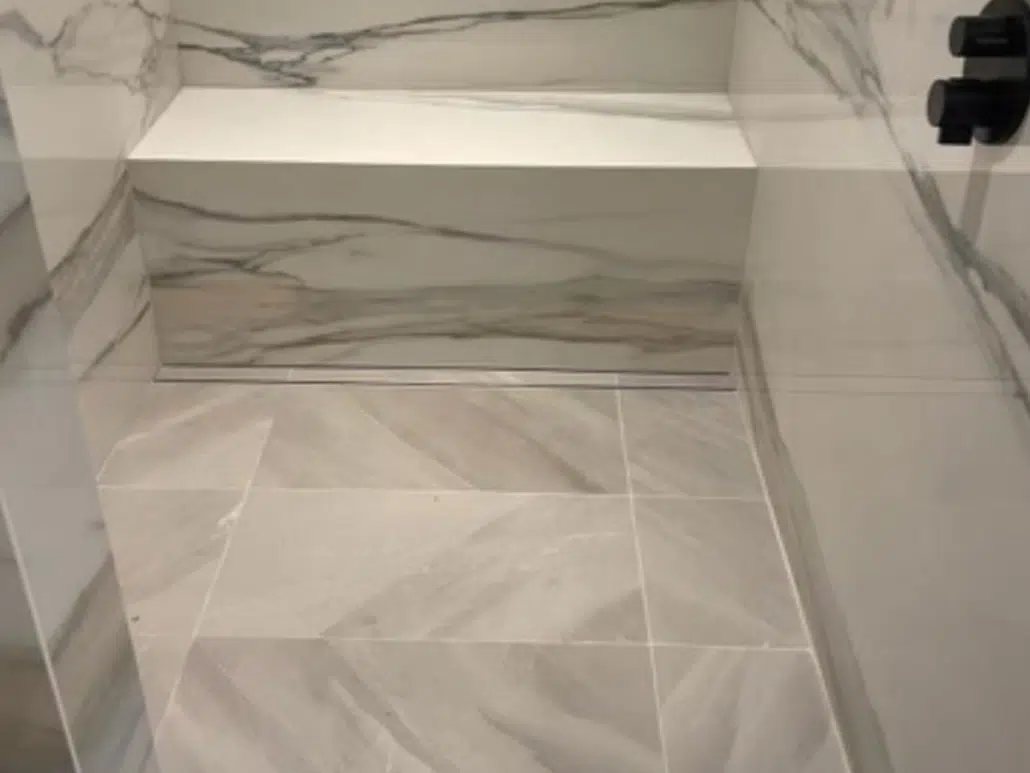
Large Tile Slabs vs. Quartz Panels: Choosing Shower Walls for Your NH Remodel
When you start planning a bathroom remodel, one of the biggest choices you will make is what to put on your shower walls. Over the last few years, the trend has moved away from small tiles with endless grout lines toward large-format options. Homeowners want something clean, elegant, and easy to maintain.
If you are looking at upgrading your shower, you are likely comparing large-format porcelain tile slabs against solid quartz panels. At Shapiro Bathrooms & More, we install both options for homeowners throughout southern New Hampshire, Hooksett, and down from the Lakes Region.
But before looking at colors and styles, it helps to understand how these materials perform long-term and what it takes to install them properly.
Video: Comparing Large Tile Slabs and Quartz Panels
Before reading about the installation details below, watch this video where Joshua Shapiro compares large porcelain tile slabs against solid stone quartz panels to help you find the right fit for your home.
The Problem with Fast “Glue-Up” Shower Systems
If you watch television or look online, you will see a lot of advertising for quick, one-day bathroom updates. These commercial systems rely on thin plastic or acrylic sheets designed to be stuck right over your old walls.
We avoid these quick-fix options because they do not offer long-term stability or protect the investment you have made in your property. Joshua Shapiro is straightforward about our stance on these fast-fix systems:
“I do not agree with any type of glue up type system. I do not agree with these fast, you know, in your house put it up over whatever it is. That is not what we do for a business. There is a huge market for that. There’s huge dollars and marketing spent on that. And there’s high pressure sales involved that is completely opposite to what we do. We wanna cater to you and, and build a project that works for you, design for you and helps hold the value of your home and will last.”
Understanding XL Porcelain Tile Slabs
 When we talk about XL slabs, we are referring to porcelain tiles that are 2 by 4 foot or even larger. These are designed to give you a clean look by drastically cutting down on the number of grout joints inside your shower.
You can even find full-size porcelain slabs that measure up to 48 inches wide by 8 feet tall. Because a standard residential shower is usually about 32 inches wide by 5 feet long, you can often run these pieces floor-to-ceiling. However, because of the layout of a standard shower, you will still have a few corner grout joints.
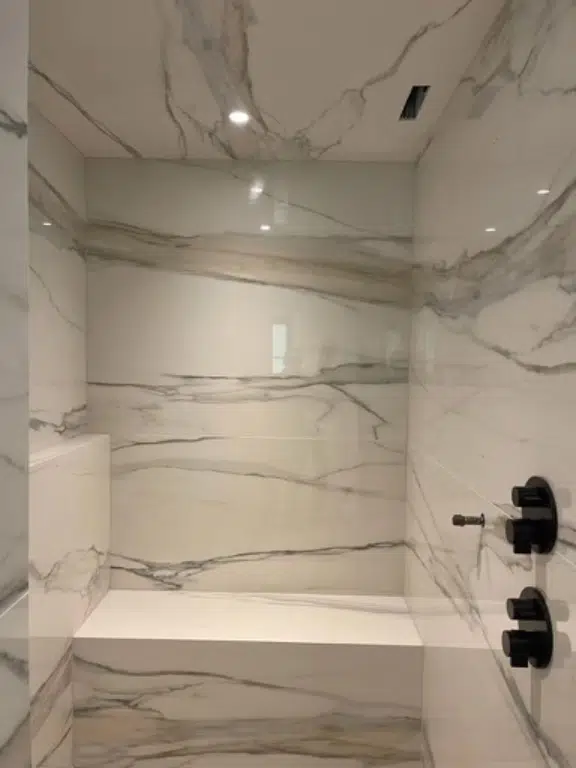
A big benefit of large porcelain slabs is that you can get them “book-matched”. This means the veining pattern on one slab matches up perfectly with the next piece, letting the design roll continuously across your walls.
The Carefree 2×4 Option
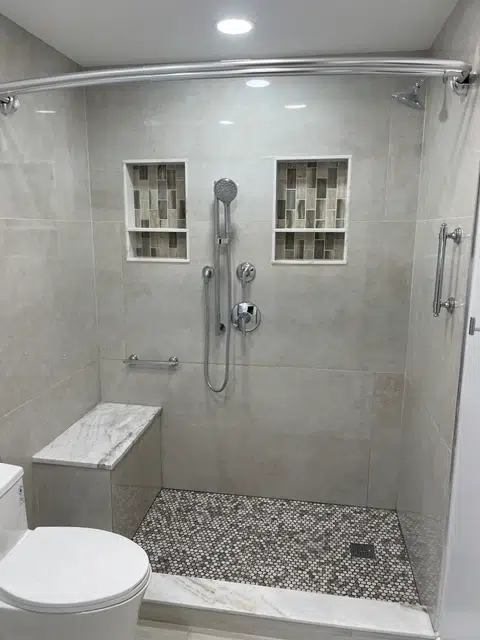
While giant 8-foot porcelain sheets look amazing, standard 2 by 4 foot tiles are actually what most New Hampshire homeowners choose if they want a carefree shower.
- They are cost-effective: Out of all the large-format options, 2 by 4 foot tiles are the least expensive to purchase and install.
- They are easy to fix: If a tile somehow gets chipped or cracked down the road, we can easily replace that single piece without tearing out the whole wall.
- They look great with built-ins: Most homeowners want to break up their shower walls with custom niches, corner shelves, or benches anyway, which naturally fits the layout of 2×4 tiles.
The Benefits of Solid Quartz Slabs
If you want to step up to something incredibly luxurious and you have the budget for it, solid stone or quartz is an exceptional choice.
Most quartz slabs used for kitchen countertops are 3 cm thick, but for shower walls, we use 2 cm slabs. This slightly thinner profile keeps the weight down and allows the stone to finish flush against traditional drywall edges.
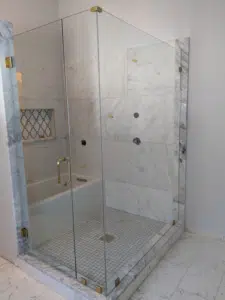
Because a standard quartz slab is massive—roughly 63 inches wide by 120 inches long—you get enough coverage to go completely floor-to-ceiling and handle a full back wall with no seams at all. We also install these solid slabs over bathtubs. We can construct a custom recessed niche out of the same stone so that the veining waterfalls into itself. It creates an incredibly elegant feature.
With full quartz panels, you completely eliminate traditional grout lines on your flat walls. The only spots that require a seal are the corners of the shower and the very bottom where the stone ties into your bathtub or shower base. Additionally, quartz is naturally hyper-allergenic, making it an excellent choice for a clean, hygienic shower.
Waterproofing Integrity: What Matters Most Behind Your Shower Walls
Whether you choose porcelain tiles or solid quartz slabs, the most important part of the job is the prep work behind the wall.
Houses need to breathe. When you install massive, solid slabs of quartz or porcelain, you are creating a completely airtight barrier on that wall. If your contractor does not build the wall behind it correctly, the temperature difference between the cold stone and the warm air inside your bathroom can cause hidden moisture to build up.
Before the stone ever goes up, we look at your whole house:
- Ventilation: We evaluate the exhaust fan situation in your bathroom to make sure it can handle the steam.
- The age of your home: Older homes settle and shift differently than brand-new builds, which affects how we prep the framing.
- The attic space: If your bathroom is on the second floor, we check to make sure the attic directly above it is insulated properly.
To prevent moisture issues, we use a fully waterproofed, professional backing system behind the stone, such as a Wedi or Schluter system over GoBoard. Sometimes we build what we call a “Frankenstein” system, combining the best parts of multiple professional systems to ensure the wall behind your slab stand-up is completely waterproofed and built to handle New Hampshire’s seasonal temperature swings.
The Shapiro Approach to Grout
When you use standard 2 by 4 foot tiles, the grout joints are incredibly tight—just a sixteenth of an inch wide. Some contractors will tell you to use an epoxy grout because it is as hard as the tile itself. While epoxy is strong, it can be incredibly difficult to deal with if you ever need to make a repair down the road.
We prefer a more practical approach for long-term maintenance:
“We do recommend not an epoxy grout, but like a CQ, which is a hybrid, which is gonna be able to be scraped out if you need to in 10 years and regrout it. To us, it’s just a little simpler of a better process.”
Using a hybrid grout gives the tile room to breathe while ensuring that if you want to refresh the look of your shower in a decade, the job can be done cleanly and easily.
Frequently Asked Questions | Shower Walls FAQ
Q: Which option is better for home resale value?
A: It really depends on your specific home and where you live. You do not want to overbuild for your neighborhood. If you live in an area where quartz is the standard for high-end homes, it can give you a great return on resale. If a budget-friendly option makes more sense for your property, 2 by 4 foot porcelain tile gives you the exact same carefree, low-maintenance benefits at a fraction of the cost.
Q: Are full quartz panels too heavy for an older house?
A: Because quartz is heavy, it requires solid framing behind it. That is why we use 2 cm slabs instead of the heavier 3 cm countertop slabs, and we always inspect your home’s structural joists and studs during the prep phase to make sure everything is completely reinforced before installation.
Q: What is book-matching, and can I do it with quartz?
A: Book-matching is when two matching slabs are cut and installed so that the natural veining lines up perfectly at the seam, looking like an open book. This is very popular with large porcelain tile slabs and natural stone quartz that features heavy marble-style veining.
Q: How long does a hybrid CQ grout last compared to epoxy?
A: Hybrid CQ grout holds its color and resists stains remarkably well, lasting for years. The real benefit over epoxy is that if it ever gets stained or discolored after a decade of hard use, we can cleanly scrape it out and regrout the shower without damaging your tile. Epoxy grout cures as hard as stone, meaning you often have to chip the tile itself just to fix a grout line.
Compare Slab and Tile Options in Person
There is no single shower wall material that is perfect for every single home, but there is absolutely a right choice for yours. We would love to help you find it. At Shapiro Bathrooms & More, we operate as a family business with a strict no-pressure policy.
If you want to see large-format tiles and solid quartz options side-by-side, you can schedule an appointment to visit our local showroom:
Shapiro Bathrooms & More Showroom
11 Kimball Drive, Hooksett, New Hampshire
We can look at your space, discuss your home’s needs, and map out a plan that fits your target budget perfectly. Give us a call or reach out online to schedule an in-home site visit with us today.

