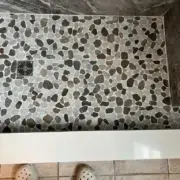
Tile vs. Acrylic Showers
The Honest Comparison for New England Homeowners
Stepping onto a cold bathroom floor at 6:00 AM in February is a distinct New England rite of passage. Whether you live in a drafty Victorian in Concord or a mid-century Cape in Manchester, the physical reality of your bathroom matters just as much as the aesthetic one.
When homeowners finally decide to address that drafty, outdated shower, they almost immediately hit a wall of decision paralysis. Tile or Acrylic? The renovation industry is full of noise, with New England bath contractors often pushing the one material that makes them the most profit.
Comparing Tile & Acrylic: Performance, Cost, and Value

At Shapiro Bathrooms & More, we refuse to treat your renovation like a sales quota. Because we install both custom tile and modern acrylic systems, we have no incentive to steer you toward a specific product just to protect our margins.
Our role is to act as an objective bathroom design-build guide, helping you weigh the upfront investment against the long-term reality of living with the finished product. To make the right call, we need to strip away the marketing noise and look at the raw data: how these materials handle New England winters, daily scrubbing, and your bottom line.
Material Science: The Warmth of Acrylic vs. The Permanence of Stone
Modern acrylic shower systems have come a long way from the yellowing plastics of the past. Engineered from high-density Polymethyl Methacrylate (PMMA), they are non-porous, UV-stabilized, and act as natural insulators. For homeowners who dread the winter chill, acrylic offers an immediate benefit: it absorbs heat instantly, making those early mornings significantly more comfortable.
However, for many New Englanders, nothing replaces the tactile “heft” and authenticity of natural stone or porcelain. Porcelain tile is vitrified glass fired at 1,200°C, creating a surface that is extremely hard (Mohs scale 7-9) and effectively waterproof. While it may be cooler to the touch, it offers a sense of solidity and permanence that synthetic materials simply cannot replicate. It feels structural, not just cosmetic.
Maintenance and Longevity: Convenience vs. Indefinite Lifespan

Acrylic wins on daily convenience. Because the surface is non-porous and seamless, there is no grout for mold to root into, making it incredibly easy to clean with mild soap. However, acrylic has a finite lifespan—typically estimated at 10 to 20 years before surface wear becomes an issue. Furthermore, if an acrylic pan cracks, it often cannot be patched invisibly; the entire unit requires replacement.
Tile, by contrast, plays the long game. While the grout lines require annual sealing to prevent moisture intrusion and discoloration , the tile itself has an indefinite lifespan, easily lasting 50 years or more. Moreover, tile is repairable. If a single tile cracks or the grout looks tired, a skilled craftsman can replace the tile or “re-grout” the shower to make it look brand new without tearing out the entire system.
The Economics: Efficiency vs. Craftsmanship
The price gap between these systems is significant, but it is important to understand what you are paying for. Acrylic is an assembly process; because panels are prefabricated to precise measurements, we can often install a complete system in just 1 to 2 days. This efficiency keeps labor costs low, with high-end projects landing between $12,000 and $18,000.
A custom tile shower, however, is a construction project that demands a master artisan. The process involves demolition, complex waterproofing, and days of setting and grouting by hand, typically spanning 5 to 10 days. You are paying for skilled human capital—craftsmanship that ensures water flows perfectly to the drain. This pushes the cost to $20,000 – $35,000+, but for that price, you are getting an asset rather than a manufactured product.
| Feature | Acrylic System | Custom Tile System |
|---|---|---|
| Cost Range | $12,000 – $18,000 | $20,000 – $35,000+ |
| Install Time | 1 – 2 Days | 5 – 10+ Days |
| Heat Retention | Warm (Insulator) | Cold (Conductive) |
| Maintenance | Low (Wipe down) | High (Sealing required) |
| Lifespan | 10 – 20 Years | 50+ Years |
The Aesthetic Choice: “Real” Luxury vs. Simulation
Acrylic systems have evolved to mimic the look of granite and marble, but they remain simulations. For a modern, minimalist “wet room” look, they are sleek and functional, but they lack the depth and variation of the real thing.
Tile offers infinite design freedom. Whether it is a complex herringbone pattern, a contrasting niche for shampoos, or a listello border, tile allows you to create a unique piece of art. For historic homes in Concord or Portsmouth, tile is the “gold standard” that respects the architecture.
In the luxury real estate market, a custom-designed tile shower signals high value and attention to detail that a prefabricated system—no matter how high quality—rarely achieves.
The Verdict: Which System Belongs in Your Home?
At Shapiro Bathrooms & More, we don’t believe in a “best” material, but we do believe in the right investment for your home.
Choose an Acrylic System If:
- You prioritize ease. You want a low-maintenance surface that cleans up in seconds.
- You need speed. You cannot have your bathroom out of commission for two weeks.
- You are budget-conscious. You prefer to allocate your budget to fixtures rather than labor hours.
Choose Custom Tile If:
- You want a “Forever” bathroom. You are willing to maintain grout in exchange for a 50-year lifespan.
- You value artistry. You want a custom design that cannot be bought out of a catalog.
- You are investing in resale. You own a historic or luxury home where natural materials are expected.

Stop Guessing, Start Planning
Renovating a bathroom in New Hampshire involves dozens of small decisions that add up to a major investment. You shouldn’t have to navigate the technical details and labor costs alone. Whether you need the rapid efficiency of acrylic or the elegance of custom-installed tile, we can help you run the numbers and execute the vision.
Is it time to fix your bathroom? Let’s talk about what’s actually possible in your space.